
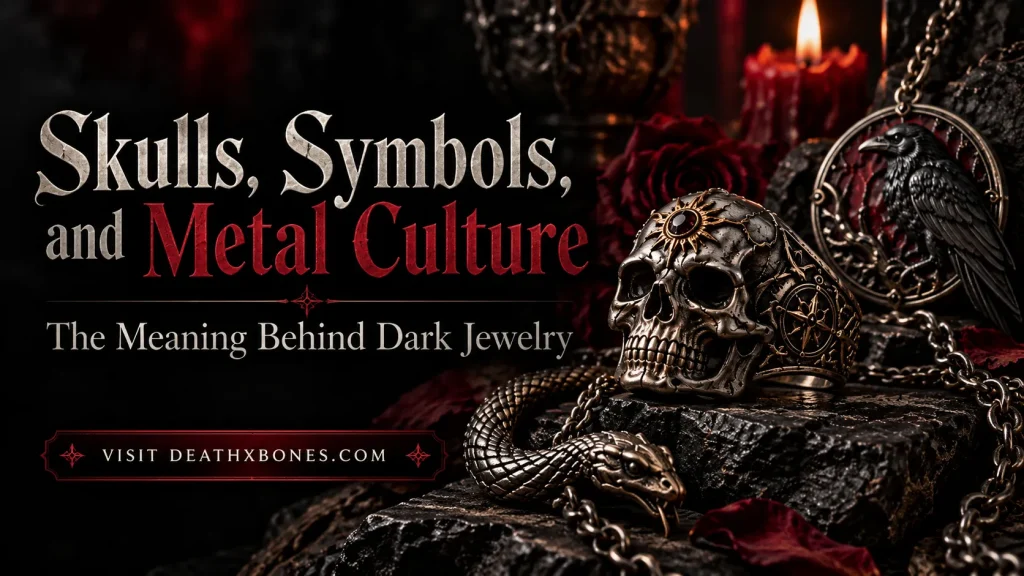
Skulls, Symbols, and Metal Culture: The Meaning Behind Dark Jewelry. Dark jewelry is more than blackened metal, oversized rings, or aggressive-looking designs. Behind skulls, occult-inspired symbols, deep reliefs, aged patina, and underground aesthetics lies a visual language shaped by centuries of art, ritual, rebellion, music, and personal identity.
For some people, a skull represents death. For others, it is a reminder to live with purpose. Within metal culture, the same symbol can represent resistance, individuality, brotherhood, transformation, or respect for a particular artist, band, or creative movement.
Understanding the meaning behind dark jewelry therefore requires more than looking at its appearance. It involves exploring symbolism, craftsmanship, materials, music culture, historical references, and the personal stories attached to each piece.
This article explores how skulls, symbols, and metal culture have shaped modern dark jewelry—and why these pieces often carry far more meaning than ordinary fashion accessories.
What Is Dark Jewelry?
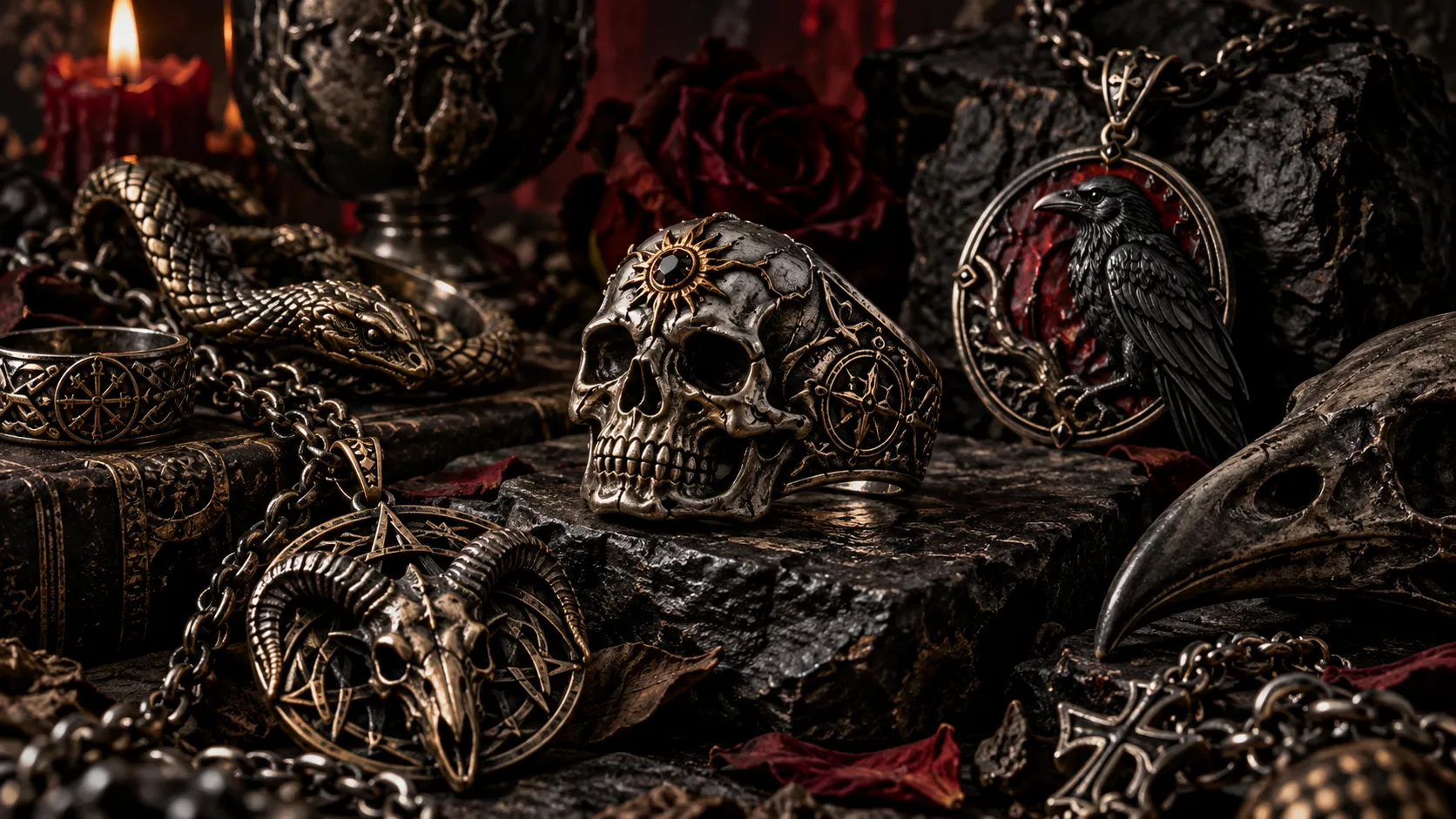
Dark jewelry is a broad term used to describe jewelry influenced by gothic, metal, occult, industrial, underground, macabre, and alternative aesthetics.
It may include:
- skull rings;
- sculptural pendants;
- signet rings with symbols;
- heavy belt buckles;
- metal chains and accessories;
- demon or mythological imagery;
- band-inspired jewelry;
- custom pieces influenced by tattoos, artwork, or underground visual culture.
However, dark jewelry does not always need to feature skulls or overtly macabre symbols.
Its identity can also be created through surface texture, oxidized metal, rough finishes, heavy proportions, deep engraving, asymmetrical forms, and aged patina.
These characteristics often make dark jewelry feel closer to wearable art than conventional accessories.
For many collectors, the purpose is not simply to wear something attractive. Jewelry becomes a way to express personality, music taste, personal philosophy, artistic identity, or connection to a specific subculture.
Why Are Skulls So Closely Associated with Dark Jewelry?
The skull is one of the most recognizable symbols in dark art.
Yet reducing its meaning to death alone would oversimplify its cultural and artistic significance.
Throughout history, skull imagery has represented several different ideas.
The Skull as a Reminder of Mortality
One of the oldest interpretations is connected to the concept of memento mori.
The phrase is commonly understood as a reminder that human life is temporary.
Rather than being purely negative, mortality symbolism can encourage people to value time, make meaningful decisions, and live consciously.
This is why a skull ring can hold deeply personal meaning.
To one person, it may represent a simple philosophy:
Life does not last forever, so live according to your own values.
In this context, the skull is not a symbol of despair.
It becomes a symbol of awareness.
The Skull as a Symbol of Courage
Skulls are also frequently associated with courage and fearlessness.
Across different cultures and subcultures, skull imagery can communicate an acceptance of danger, uncertainty, mortality, and hardship.
Over time, that symbolism became connected to resilience and bravery.
In jewelry design, this can be expressed through:
- aggressive facial structures;
- pronounced jawlines;
- deep eye sockets;
- exaggerated bone anatomy;
- heavy ring proportions;
- deeply carved relief.
The stronger the sculptural treatment, the stronger the visual statement often becomes.
The Skull as a Symbol of Transformation
Symbolic death does not always represent an ending.
It can also represent change.
One stage of life ends so another can begin.
Because of this, skull jewelry can become a symbol of:
- surviving a difficult period;
- personal transformation;
- leaving an old identity behind;
- beginning a new chapter;
- resilience after loss;
- rebuilding oneself.
This is one reason dark jewelry can become highly personal.
Two people may wear almost identical skull rings while assigning completely different meanings to them.
The Connection Between Dark Jewelry and Metal Culture
The relationship between dark jewelry and metal culture developed naturally.
Heavy metal has never communicated only through sound.
The genre has also created a distinctive visual language through:
- album artwork;
- band logos;
- stage design;
- typography;
- tattoos;
- fashion;
- merchandise;
- illustration.
Jewelry eventually became another important medium for that visual identity.Jewelry as Part of Metal Identity
Within metal culture, fashion rarely exists as a separate element.
Leather jackets, band shirts, boots, patches, tattoos, chains, rings, and pendants often work together to create a recognizable identity.
Jewelry adds another dimension because it can be more permanent than traditional merchandise.
A shirt may eventually wear out.
A well-made metal ring can remain with its owner for decades.
Some pieces may even become collectible objects or personal artifacts that are passed down over time.
This gives jewelry a different emotional weight.
From Album Artwork to Wearable Art
One of the most interesting aspects of dark jewelry is the translation of visual art into three-dimensional objects.
Artwork that originally appears on:
- album covers;
- posters;
- band logos;
- illustrations;
- tattoo designs;
- merchandise;
can be transformed into sculptural relief on rings, pendants, buckles, and other objects.
This process is not simply a matter of placing a logo on a piece of metal.
A two-dimensional image needs to be redesigned so it remains readable and visually powerful in three dimensions.
Designers must consider:
- relief depth;
- line thickness;
- negative space;
- surface curvature;
- structural strength;
- proportions;
- shadows;
- light reflection.
This is where jewelry design begins to overlap with sculpture.
The final object becomes more than merchandise.
It can become a collectible artifact with its own material presence and sculptural identity.
Common Symbols in Dark Jewelry and What They Represent
Skulls are not the only symbols used in dark jewelry.
Many other visual elements appear frequently.
Their meanings are not always universal, but some interpretations are widely recognized.
1. Snakes and Serpents
The snake is one of the oldest symbolic creatures in human history.
Depending on context, it may represent:
- transformation;
- rebirth;
- danger;
- knowledge;
- instinct;
- cycles of life.
Because snakes shed their skin, they are often associated with renewal and transformation.
Their long, flexible form also makes them highly suitable for rings, bracelets, and pendants.
2. Ravens and Crows
Ravens and crows have strong associations with mythology, folklore, and dark art.
They are often connected to:
- intelligence;
- mystery;
- death;
- prophecy;
- transition;
- the unknown.
Their distinctive silhouette also translates effectively into jewelry.
A raven pendant, for example, can remain visually recognizable even when reduced to a relatively small scale.
3. Horns, Creatures, and Mythological Forms
Creature imagery offers extensive possibilities for storytelling.
Horns may represent strength.
Mythological creatures may symbolize chaos.
Monsters may represent fear, rebellion, instinct, or the willingness to confront uncomfortable realities.
In dark jewelry, symbolism does not always need to be literal.
Like visual art, jewelry can leave interpretation open to both the creator and the wearer.
4. Sigils and Geometric Symbols
Geometric symbols create a different visual character from figurative imagery such as skulls.
They can appear more minimal while still carrying a dark or mysterious atmosphere.
Common approaches include:
- sigils;
- symmetrical patterns;
- monograms;
- geometric structures;
- symbolic typography.
These designs work particularly well on signet rings and pendants.
However, understanding the original context of a symbol is important.
Not every symbol is purely decorative.
Some may carry religious, historical, political, cultural, or spiritual significance.
Research should therefore remain part of the design process.
How Materials Influence the Character of Dark Jewelry
Symbolism is only one part of dark jewelry.
Material also plays an important role in the final character of a piece.
Sterling silver and brass, for example, create very different visual experiences.
Sterling Silver
Sterling silver has a naturally bright appearance when polished.
However, combining silver with oxidation or dark patina can create strong contrast.
Raised surfaces can remain polished while recessed details stay darker.
This technique works particularly well for:
- skull designs;
- engraved lettering;
- sculptural details;
- ornate relief;
- symbolic patterns.
The contrast creates greater depth and makes intricate details easier to read.
Brass
Brass has a warmer and more industrial tone.
Its character can feel very different from silver.
When aged or given specific surface treatments, brass can develop an antique, industrial, or weathered appearance.
This makes it especially effective for larger objects such as:
- belt buckles;
- heavy rings;
- sculptural pendants;
- statement accessories.
The natural weight and tone of brass can reinforce the physical presence of a dark jewelry piece.
Patina: When Imperfection Becomes Character
In traditional fine jewelry, perfectly polished surfaces are often considered ideal.
Dark jewelry frequently takes a different approach.
Patina, oxidation, uneven coloration, hand-finishing marks, and surface texture can become important parts of the design.
These characteristics make each piece feel alive.
Metal surfaces naturally evolve through exposure to:
- air;
- moisture;
- skin oils;
- friction;
- polishing;
- storage conditions.
Over time, two pieces that originally looked identical may develop slightly different surfaces.
For many collectors, that aging process adds personality.
The piece begins to reflect the way it has been worn and handled.
Handmade Jewelry and the Value of Craftsmanship
Dark jewelry has a particularly strong connection to craftsmanship.
This is especially true for designs involving deep relief, sculpture, engraving, and detailed surface work.
One of the best-known production techniques in jewelry making is lost-wax casting.
In general, the design is first created as a wax model.
The wax is then used to create a mold system before molten metal replaces the original form.
Casting, however, is only one stage of the process.
A piece may still require:
- cleaning;
- filing;
- grinding;
- surface refinement;
- engraving;
- oxidation or patina;
- polishing;
- final inspection.
This explains why even a relatively small handcrafted ring may require considerable work.
The process is one of the major differences between artisan dark jewelry and ordinary mass-produced accessories.
Dark Jewelry as Personal Identity
Ultimately, identity is one of the strongest reasons people wear dark jewelry.
Not everyone wants jewelry that looks neutral or conventional.
Some people deliberately choose pieces that immediately communicate character.
Dark jewelry can function as a form of visual language.
Someone may wear it because they:
- identify with metal culture;
- connect with specific artwork;
- appreciate gothic aesthetics;
- collect artisan work;
- enjoy sculpture;
- value handcrafted objects;
- want jewelry that does not look generic;
- associate a symbol with a personal life experience.
This helps explain why dark jewelry has a relatively specific but highly dedicated audience.
The value of a piece does not come only from metal weight or technical complexity.
It can also come from the relationship between the object and its owner.
How to Choose the Right Dark Jewelry
If you are beginning to wear or collect dark jewelry, do not judge a piece only by its appearance.
Understand the Symbol
Know what you are wearing.
If a design includes religious, historical, cultural, or political symbolism, research its original context.
This helps ensure that the meaning aligns with your intention.
Consider the Material
Pay attention to the metal used.
Silver and brass have different characteristics in terms of:
- color;
- weight;
- maintenance;
- aging;
- patina;
- surface behavior.
Choose according to both appearance and practical use.
Choose the Correct Size
Statement rings can be visually large while still being comfortable.
Ring sizing is especially important because thick bands may feel different from conventional thin rings.
A properly sized piece should feel secure without restricting natural movement.
Examine the Craftsmanship
Look carefully at:
- relief depth;
- casting consistency;
- surface finishing;
- engraving;
- structural details;
- edges;
- back construction;
- transitions between surfaces.
Small details often reveal whether a piece was designed as a genuine sculptural object or simply manufactured as a decorative accessory.
Dark Jewelry Is More Than a Trend
Skulls, gothic symbols, and metal aesthetics existed long before dark jewelry became visible through social media.
Their long-lasting appeal comes from symbolism rather than short-term trends.
A skull ring may connect with the concept of memento mori.
A band collaboration piece can become memorabilia from a particular musical era.
A custom pendant may preserve a symbol that has meaning only to its owner.
For this reason, dark jewelry should not always be viewed purely as a fashion statement.
It can become a personal artifact.
A small physical object capable of carrying music, art, craftsmanship, memory, and identity at the same time.
From Metal Culture to Wearable Collectibles
For Deathbones, dark jewelry exists at the intersection of metal culture, sculpture, symbolism, and craftsmanship.
The goal is not simply to make objects that look dark or aggressive.
The more important question is how an idea can be translated into a piece with identity.
A skull can represent mortality.
A symbol can carry history.
Metal culture can create community.
Craftsmanship transforms those ideas into physical form.
When these elements come together, jewelry becomes more than an accessory.
It becomes something that can be worn, collected, preserved, and given personal meaning by its owner.
Explore the World of Deathbones
If you are looking for jewelry with a stronger identity, explore the Deathbones Collection and Collaborations to discover handcrafted rings, pendants, buckles, and metal pieces shaped by underground art and metal culture.
For something more personal, visit the Custom Order section and discuss an original concept designed around your own symbolism or visual direction.
Explore the collection and stories behind each piece at deathxbones.com.